
The Proven Community Connection Framework: Why Your Mental Health Needs More Than Just Therapy
Okay, let's be real about something that's been eating at me lately. I've been in therapy on and off for years - and don't get me wrong, it's been life-changing. But there's this nagging feeling that something's still missing, you know? Like I'm doing all this inner work in isolation, and then I step back into the real world and... fuck, it's still hard.
Maybe you've felt this too? You leave your therapist's office feeling centered and clear, armed with all these coping strategies, only to get home and realize you're still fundamentally alone with your thoughts. It's such a shitty place to be, especially when you're doing "all the right things" for your mental health.
This is where the whole community connection thing comes in, and honestly, it's changed everything for me.
The Thing About Therapy That Nobody Talks About
Here's what I've learned the hard way: traditional therapy is amazing for understanding our patterns, processing trauma, and developing coping skills. But it's inherently designed around this one-on-one, isolated model. You and your therapist, in a room, working through your stuff.
But we're not meant to live in isolation, despite how difficult it can be to remember that sometimes. Humans are fundamentally social creatures, and our mental health is deeply intertwined with our connections to others. When we only focus on individual healing, we're missing this massive piece of the puzzle.
Research backs this up too - people with strong community ties have better access to mental healthcare, lower rates of depression and anxiety, and more resilience when life gets tough. It's not just correlation either; community involvement actually changes how our brains process stress and connection.
Who comes up with these things, right? Like, why didn't anyone tell me sooner that maybe the reason I was still struggling wasn't because I wasn't "therapying" hard enough, but because I was trying to heal in a vacuum?
What Actually Makes Community Work for Mental Health
I've been digging into this stuff, and there's this framework that keeps coming up - not the fancy academic kind, but the real-world, actually-works-for-regular-humans kind. It's built around four core elements that work together, and honestly, it's pretty simple when you break it down.
Strategy is basically having some kind of direction or shared purpose. This doesn't have to be complicated - it could be a book club where everyone's struggling with anxiety, or a hiking group for people who need to get out of their heads. The point is there's something that brings you together beyond just "we all have problems."
Culture is about creating a space where people can be real. No Instagram-perfect bullshit, no pretending everything's fine when it's not. A place where someone can say "I had three panic attacks this week" and instead of awkward silence, they get "Yeah, me too, what helped?" or "That sounds really hard."
Platform is just the practical stuff - where do you meet? Is it virtual, in-person, both? I've found that consistency matters more than perfection here. A regular coffee shop meetup can be just as powerful as some elaborate wellness retreat.
And the Community Manager piece - this is usually someone who keeps things flowing, helps new people feel welcome, and gently steers conversations when needed. It doesn't have to be official, but every healthy group seems to have someone who naturally fills this role.
Why This Hits Different Than Therapy Alone
The thing about community that therapy can't replicate is belonging. Real belonging, where you're accepted for being exactly who you are - messy anxiety, weird coping mechanisms, bad days and all. It's not about fitting in or performing wellness; it's about finding your people.
I remember the first time I shared something really vulnerable in a group setting and instead of judgment or advice, I just got this wave of "me too" responses. It was like... oh. I'm not broken or uniquely fucked up. This is just part of being human, and there are other humans going through it too.
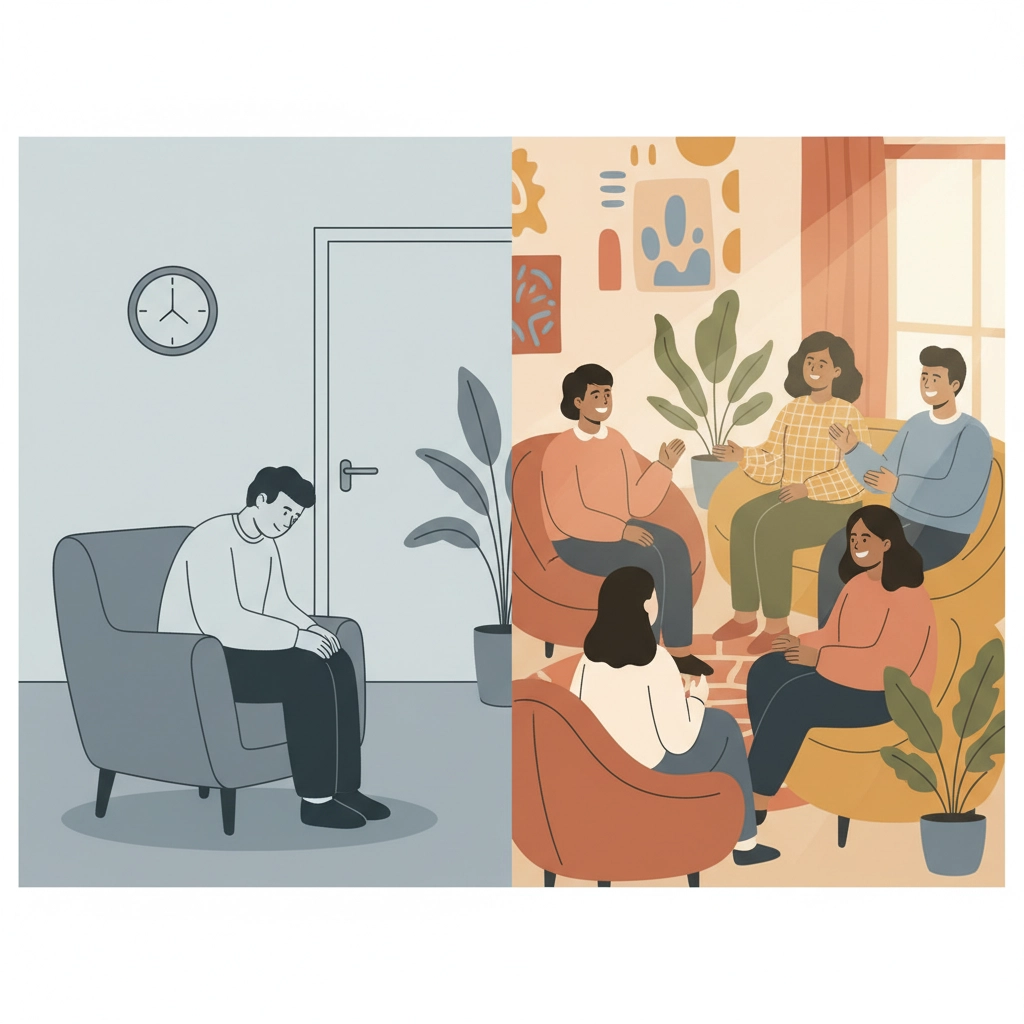
Connection works differently than individual work too. In therapy, you're processing and understanding. In community, you're witnessing and being witnessed. You see how other people handle similar struggles, you learn new ways of being, and sometimes you realize that your coping strategy that feels weird or inadequate is actually pretty brilliant.
And the support piece - god, this has been huge for me. Not just emotional support, though that's important, but practical stuff too. Someone in my anxiety support group told me about their psychiatrist when I was struggling to find one. Another person shared resources for sliding-scale therapy. These are things that individual therapy, no matter how good, just can't provide.
The Real Talk About Finding Your People
I'm not gonna lie - finding authentic community as an adult is fucking hard, especially when you're dealing with mental health stuff. There's this catch-22 where you most need connection when you feel least able to reach out for it.
But here's what I've learned: you don't have to find the perfect group or create some elaborate support system. Start small. Really small. Maybe it's joining a Discord server for people with your specific flavor of mental health challenges. Maybe it's showing up to a local meetup even when (especially when) you don't feel like it.
I started with online communities because they felt safer. Less commitment, easier to lurk until I was ready to participate. Then I found some local stuff - nothing fancy, just people who gathered regularly and weren't trying to fix each other, just trying to not feel so alone.
Making It Work Alongside Traditional Treatment
The beautiful thing about community-based mental health support is that it doesn't replace therapy - it amplifies it. I still see my therapist regularly, but now I have this network of people who get it. When I learn something useful in therapy, I can share it with my group. When someone in my community shares a strategy that works for them, I can explore it more deeply in individual sessions.
It's like having multiple layers of support instead of putting all the pressure on one relationship or one approach. Some days I need professional guidance, some days I need peer support, some days I just need to know I'm not the only one having a really hard time with everything.
We talk a lot about mental health being a journey, but I think we forget that journeys are usually better with companions. Even when you're doing your own inner work, having people who understand the terrain makes such a difference.
The Stuff That Actually Matters
Look, I could go on about research and frameworks, but here's what actually matters: finding spaces where you can be honest about how hard things are sometimes, where your struggle is met with understanding instead of solutions, and where you can witness other people's resilience and learn from it.
It might be a formal support group, or it might be a group chat with people you met on Reddit. It could be a wellness community at work, or a book club that accidentally became a place where people share their real shit. The format matters less than the authenticity.
What I've learned is that healing happens in relationship - not just the therapeutic relationship, but in community, in friendship, in the messy, imperfect connections we make with other humans who are also figuring it out as they go.
We don't have to do this alone, despite how difficult it can be to remember that when we're in the thick of it. And honestly? We're not supposed to. The framework isn't complicated - it's just about creating spaces where we can be real with each other and support each other through the inevitable ups and downs of being human.
Maybe that's the real framework: show up, be honest, listen well, and remember that we're all just trying to figure this out together. Not perfect, but definitely better than going it alone.
